
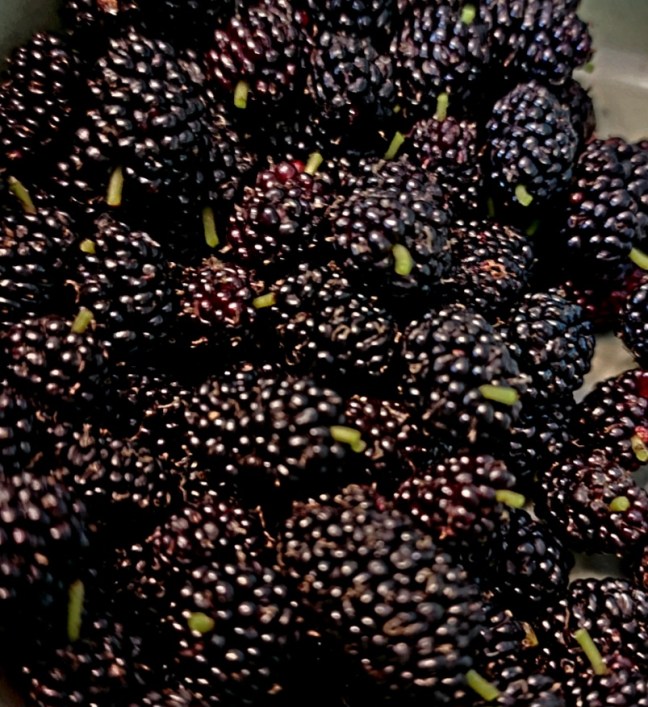
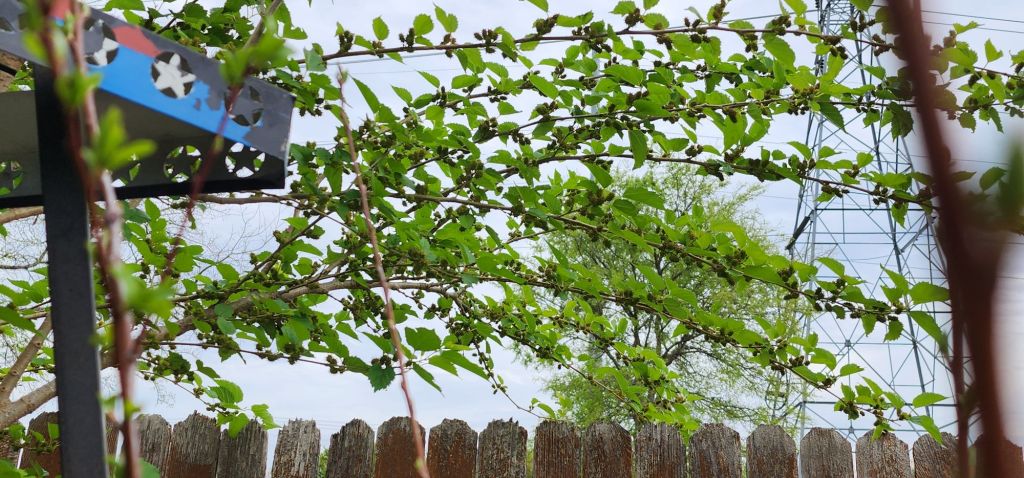
These were sold to me as: “Dwarf everbearing morus nigra” the link above says that that is not correct: That everbearing varieties are not nigras, they are albas. However: this tree produced fruit for a month or so last year (it’s first year.) So tasty! I don’t mind that I was duped into buying something other than what I was looking for. The fruit on this is still fantastic. Real nigras can get to 70 feet and I didn’t have room for that. That’s why I ordered the dwarf everbearing. Now I’m glad I did!
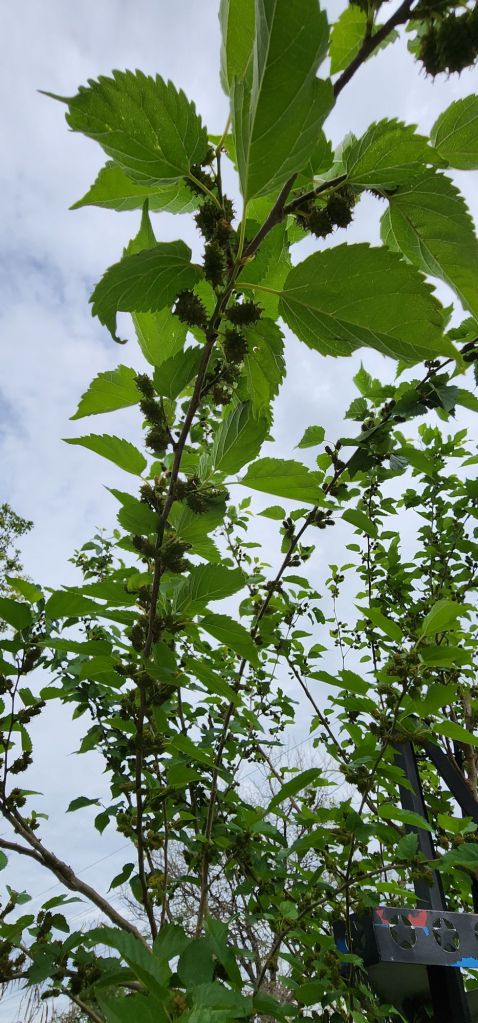
Loaded with fruit. Expect to net it from birds and squirrels. I harvest by laying a tarp down and shaking the limbs. Ripe fruit easily drops from it.
When I first purchased this tree I did a lot of research. When I finally figured out the everbearing was not a nigra, I emailed my local extension office to help with identification. What I got back was a garbled mess about a different fruit tree, entirely. That almost never happens. Usually they’ll forward questions up into the teaching staff at Texas A&M and I get a thorough answer from a PhD.
I wish this was both a morus nigra and a dwarf. But since those don’t exist: it is doing really well and the fruit is excellent. The tree will stay relatively small and is planted next to a plum. So these trees need to share space. I don’t have the land open to put in another mulberry, unfortunately. So, I’m just going to enjoy this one.
I went with a mulberry because I grew up eating them in Kansas and also from the bushy, wild versions in Texas. They are deliciously sweet but the ones in KS were watery and had little flavor. These are definitely not the watery kind! I much prefer them to blackberries, which are usually pretty sour for me. And I’ve repeatedly tried different varieties of those.
If you want to geek out on the science of morus nigra (it has a mess load of extra chromosomes, compared to the other mulberries.) “the species’ very high ploidy level, having 22 pairs of its 14 chromosomes in fact, making Morus nigra a decosaploid (2n=308) which is not only unique in the genus but also one of the highest recorded ploidy level for any known seed plant.”
They are supposed to be long lived, up to (and beyond) a hundred years. There’s one morus nigra claimed to be planted in the 1500’s, that is still alive.
You can use the tree to offer berries to the birds, rather than losing large fruits, but if you pass on the fruit for yourself: I really think that’s a waste. Although: you can’t eat all the fruit these trees produce, so the birds have what’s left when I’m tired of harvesting, munching and freezing mine.
Generic Alba and Rubra mulberries are watery and I don’t care for them. I definitely recommend the dwarf everbearing, though. They taste more like the Texas, wild bush mulberries I remember.
Here’s a guy that is a grower and his tour of his nursery.
In the old days, people did not cut hay as feed for their animals (like way back, during the dark ages. I am addicted to history shows.) They took top growth from fast growing trees, cut and dried the entire branch in piles in a barn and that’s what they fed their animals for winter. One of the favorites, for high protein fodder was: mulberry. You can also dry the leaves for tea or you can eat the young leaves (the best for fresh eating are supposed to be from morus alba aka the white mulberry) in salads or cooked like spinach.

This is a multi use tree. Many plusses, only negative is the fruit will stain cars and sidewalks. Just plant them in their own area. There is a white fruited mulberry. (The names of the morus: alba, nigra and rubra are not from the fruit color. It has something to do with leaf color, but I got lost in the multitude of mixed information and gave up when my local master gardeners couldn’t help. The naming based on leaf color, rather than fruit, is the biggest reason people mix this plant up!) The white fruited mulberry is supposed to resemble honeydew melons and not stain anything with fruit drop.
Mulberry is a top story tree (which is why I bought the dwarf). Normally these can get to 30-70 feet depending on the species. They are fantastic shade trees. If you are growing somewhere hot, like I am, these trees supply shade for understory fruits that can’t handle our full sun.
The problem I have is: that these trees require a lot of water. You can see how juicy these are in the video I linked above. Lots and lots of sun and lots and lots of water. Our dry hot summers would not support these without some form of irrigation.
I don’t mind. Like I’ve said: the fruit is worth the water bill!
I hope you try growing a mulberry. They even have a few that will take pot culture (but they can’t dry out.)
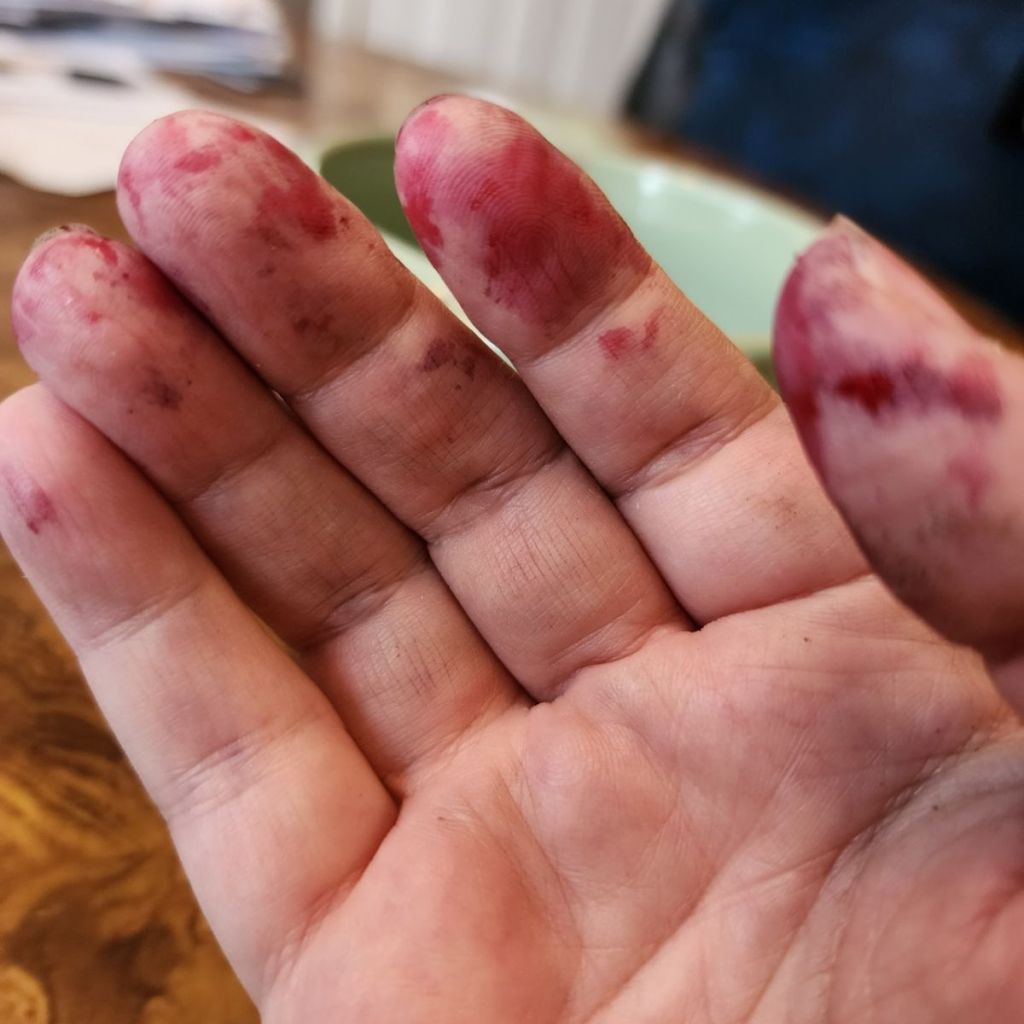
See you out in the garden with our mulberry stained hands and bowls of delicious fruit!
Discover more from Crazy Green Thumbs
Subscribe to get the latest posts sent to your email.
 Crazy Green Thumbs
Honestly, I don’t believe I have ever had a mulberry.
Well. For me blackberries are tart. These are sweet like raspberries. Lots of juice. I really recommend them! They crush when you harvest them, so you’ll never see them in the store.
Do they need a pollinator like the American red mulberries do? I grew one from a client’s tree, but I do not remember ever encountering a pollinator. Mulberries did not grow in orchards here, but a few individual trees grew as ‘decoys’ to feed birds that would otherwise eat the fruit within the associated orchards. I barely remember them, but I suspect that they were black mulberries. The biggest one that I remember, which happened to be nearby, was supposedly a red mulberry, but it made no fruit after its friend was removed for the widening of the road. It was removed for redevelopment of the site only a few years after its friend. Eventually, I would like to grow red mulberry along with more typical black mulberry.
This one does not need a pollinator. It’s loaded with fruit and I doubt anyone is growing one nearby. The problem I have with the non dwarfing ones are: how do you harvest a 50 (and up) foot tree? The ones that were watery in Kansas were tall like that. You’d randomly get a few with the tips of lower branches hanging down and you could get to those, but the majority were up too high and not worth renting a cherry picker to get at them. If you had one of the industrial sized tree shakers, that might work. They do make fantastic shade though. If I had more room I’d grow more of the dwarf everbearing and not a single ginormous tree. They were considered trash trees in Kansas because they came up everywhere. They are fast growers, so I would guess you could cut the leader off early and try to keep them low.
I suspect that those are the two primary reasons that no one grows them; they get too big, and their fruit lacks flavor. I saw them in Oklahoma, but did not bother to get cuttings, and even if I did, I had no way of knowing which were male and which were female.
Yes. I like these berries though. They are tasty. But, I may get better fruit because of the heat we have. I’m reluctant to recommend fruit outside of Texas because our growing conditions are so unique. But, for me, I’d rather have these over blackberries any day.
Black mulberries perform reasonably well here also, but are uncommon, and some cultivars are rare. Of course, I can not compare their flavor that that of those from warmer climates.
I’ve never heard of Mulberry trees … probably lucky I hadn’t because my garden is already bulging at the seems. The fruit looks delicious. I have a tayberry bush that I’ve been trying to grow for years. Now, after seeing pictures of this fruit, I wonder if it is.
Tayberry is a cross of blackberry and Raspberry. They grow on canes like raspberries and blackberries. Mulberries are a tree. And usually a giant one. The fruit does look really similar, though. I agree! Thanks for coming by and commenting. I appreciate the visit!