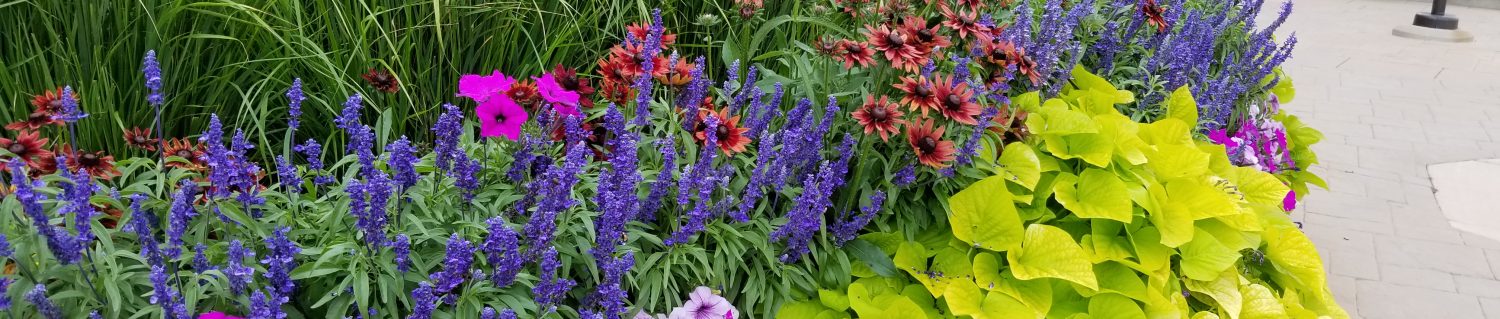


Crepe myrtles have been a symbol of the south for a very long time. Some people love them, some people hate them. I’m both. I really do not like the ones meant to mimic lilacs. But, crepe myrtles are a poor substitute for lilacs. Yes they flower with big fluffy blooms, but there’s no scent and the light purples, pinks and greenish whites are outdated and really not much to look at.
Enter the new varieties:
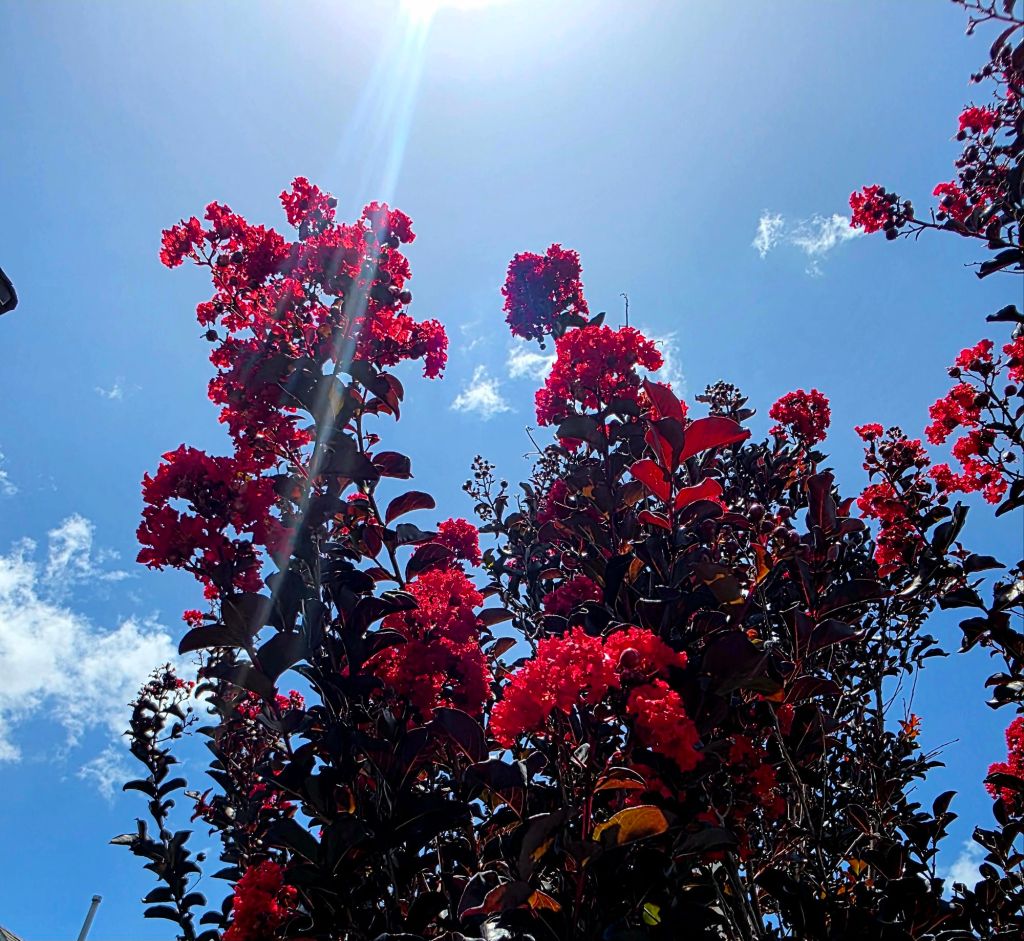
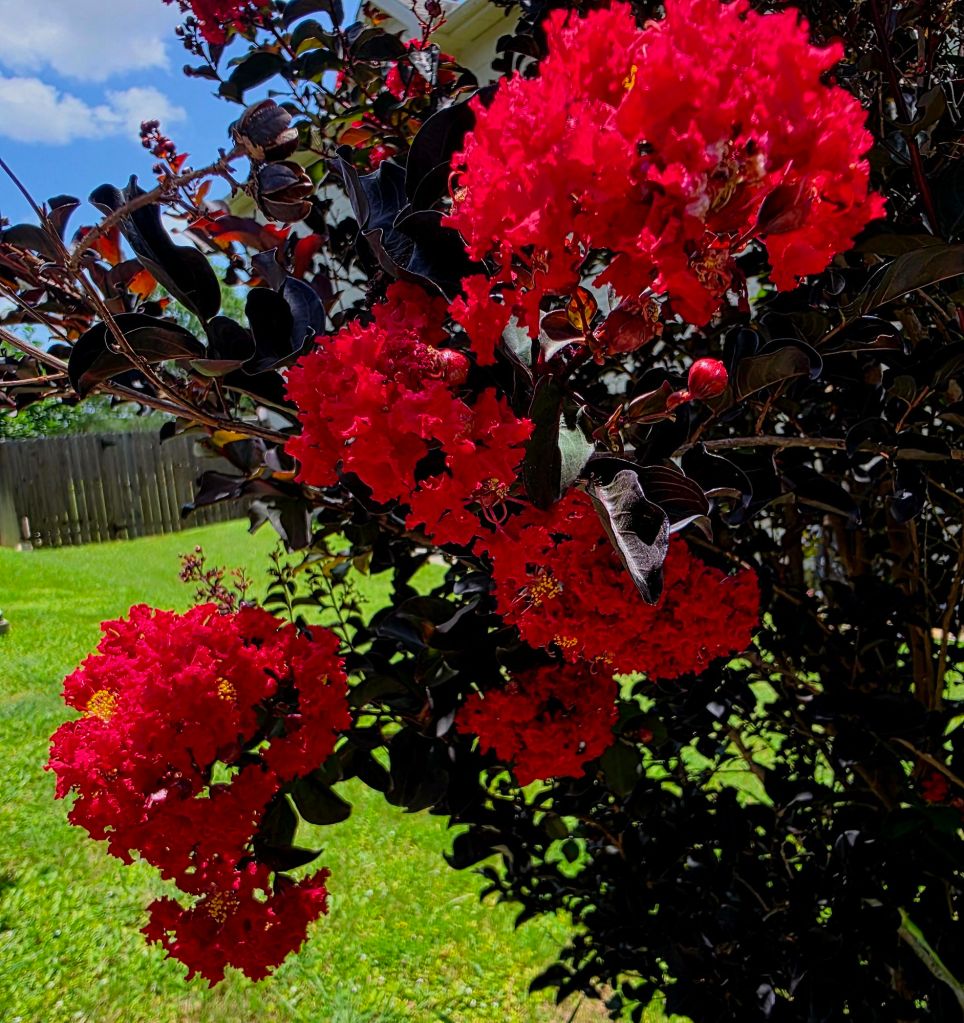
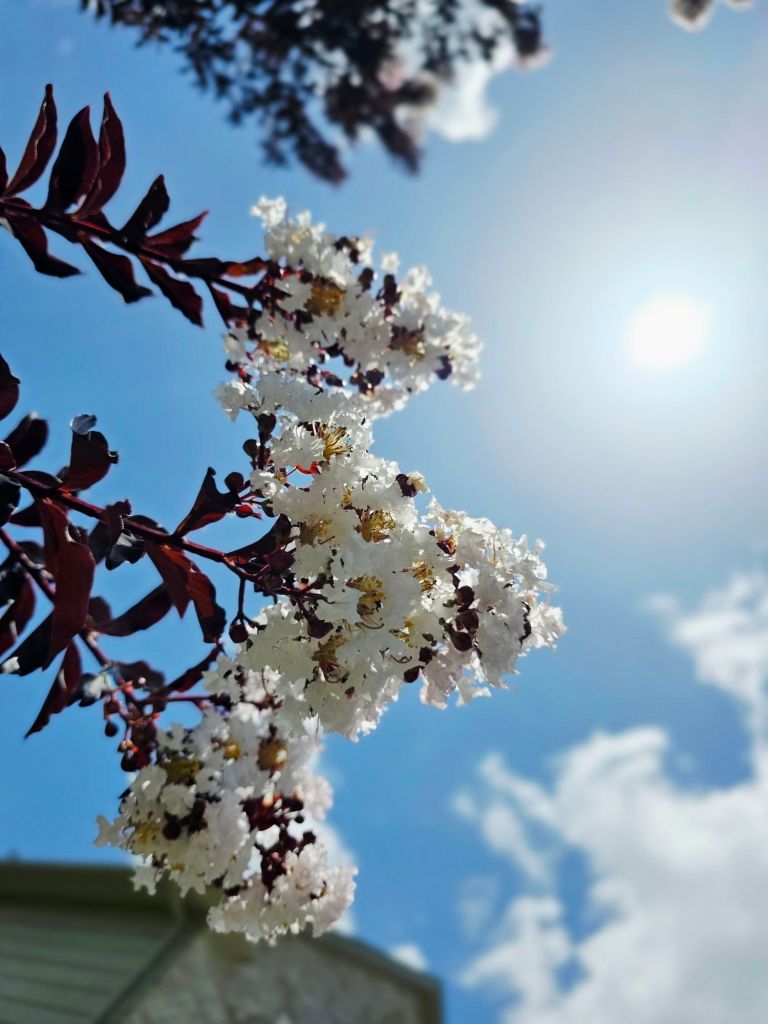
On my property, I really like to have a lot of different foliage colors in my flower beds, bushes and trees. That way, when the flowers are done: the bed still looks nice. I also appreciate the new bright blooms, no matter the foliage colors. Dark clear red and crisp whites look good on any background, but I particularly enjoy them on the merlot/chocolate foliage. The trees/shrubs that I have are 12-13 years old. Back then, they were the first dark foliage/clear colored blooms on the market. I found them to be very slow growing and I pulled the original white one because of its lackluster performance.

I replaced the original white one with a newer variety about five years ago. Although, it’s a great plant, and is performing well for me: it is a much larger plant and more upright than my original crepe myrtles.
With the red ones, I have attempted to cut low growing branches over the years, to make a standard. But: they want to be bushes and I’m tired of fighting with them.

Along with several other mainstays in my garden, these look gorgeous in the middle of our hottest time of the year.
I usually use a flowering tree and shrub, fertilizer spike, in the ground around the tree’s dripline (the shaded area on the ground that the canopy covers.) The main thing I recommend is making sure they don’t dry out when they are young.
Before you start any major plant installations, get your soil tested. You can get some simplistic kits from your local hardware store, or for a more in depth look, you can usually send it off to your local extension office or college AG division. You can do a home test to see if you have clay, sand or loam. Get a couple handfuls of soil, put it in a jar and add water until it’s damp but not wet. After a few minutes take some out and try and roll a “snake” with it between your palms. If the soil will not roll you’ve got sand. If it rolls and breaks you probably have loam (ideal). If you can roll it and it stays together in a long piece it’s clay.
I have very heavy clay with limestone rock. It’s difficult to dig, it is always either too wet or too dry. Definitely not my favorite soil for sure. However, my clay soil has almost every nutrient I need in it. I only need to add nitrogen. For that I get a bag of nitrogen for lawns and use it sparingly around anything that needs it.
Another issue with clay is it has high pH. For that, especially if you have free calcium (from limestone, in my case.) There is no long term fix. No matter what you do the calcium will overwhelm your amendments. High pH will cause all sorts of vital nutrients to be unavailable for uptake, by the plants, especially iron. Lack of iron availability is called iron chlorosis. I struggled with a pear tree and used implants I drilled into the trunk. It did let the tree live for 12 years, which it wouldn’t have without them. But, eventually it was a disease vector and fireblight bacteria got into the tree and killed it.
My soil is not what crepe myrtles prefer. They like a loamy, slightly acid soil that drains well. This is the reason I sited them on a slight slope. They do not get water logged.
Lately, it’s been really popular (and pushed by many) to add only, or mostly, native soil back into your planting hole. To this: some people will actually try and aggressively argue, sometimes really rudely, against what I’m about to say. But: years of doing both has made up my mind. I don’t put native soil back into my planting holes. I do not do that with any of the plants I plant.
I prefer to add a hugelkulter type base. I use a deep, very wide hole. And this hugelkulter set up includes logs (or hardwood mulch) at the bottom with sulphur lawn pellets. Then I add straw, leaves, compost, a light layer of manure and compost with soil. I return almost nothing native.
My native soil is awful. Digging a tree sized hole is an hours work. If you are stuck on the idea of absolutely only having native soil, make sure you understand that there are many people who do not have decent soil. Maybe the difference in recommendations is proof that you do have great soil, which is a major win for you!
I, unfortunately, do not have that. In any form.
As far as creating a “pot culture”: trees lift sidewalks, ruin foundations and break into and clog water lines. You are not going to kill or weaken your tree building something, better for it to grow in, than what your builder left you. Also, if you go around the edge of your planting hole rocking a potato fork, to break up the surrounding soil, for a couple of seasons: the roots will easily escape your hole. In comparison, I have tried using mostly native soil and my plants struggled. It’s just too dense, the pH is way to high, even my water pH is too high. It is not something homestaders would have chosen to grow in.
I grew up digging giant holes filled with purchased soil and after trying several methods I prefer removing all native soil and building an in-ground, composting structure, that will benefit my plants long term.
If you have great soil, then you can definitely fill your hole back in with what you took out. But if it takes you an hour to dig a hole. If you have to balance on the foot step of your spade (and repeatedly jump up and down until you lose your balance), to get the next inch down: don’t put that garbage back in your planting hole.
So, so far the process is: pick the full size crepe myrtle you are interested in growing. Chose the growth habit and color of your crepe myrtle. Dig a hole, plant your tree in whatever way makes sense for where you live, don’t let the tree dry out completely for the first few years, and don’t let it sit in soggy soil. Site your tree in full sun. Make a plan to fertilize, based on the soil test you should be getting back from wherever you chose to have it analyzed.
The last part I’ll put in here: is disease and or bug infestations. You can get powdery mildew or sooty mold on your trees. Powdery mildew (in my area), usually means the tree is not getting enough sun. In your area it may be that you get a lot of rain. Either way any combination of: baking soda, dish soap, neem oil, or milk, will stop powdery mildew. Sooty mold is caused by ants and the aphids they farm. Applying a layer of tangle trap (per instructions) will stop the ants and that will stop the sooty mold.
The only big bug issue I have are an extremely aggressive spider mite that spins thick webbing like web worms do. A stiff spray of the water hose usually keeps their population down. Spraying chemicals usually will not get inside the webbing to kill the mites and you will kill beneficial, predatory bugs instead.
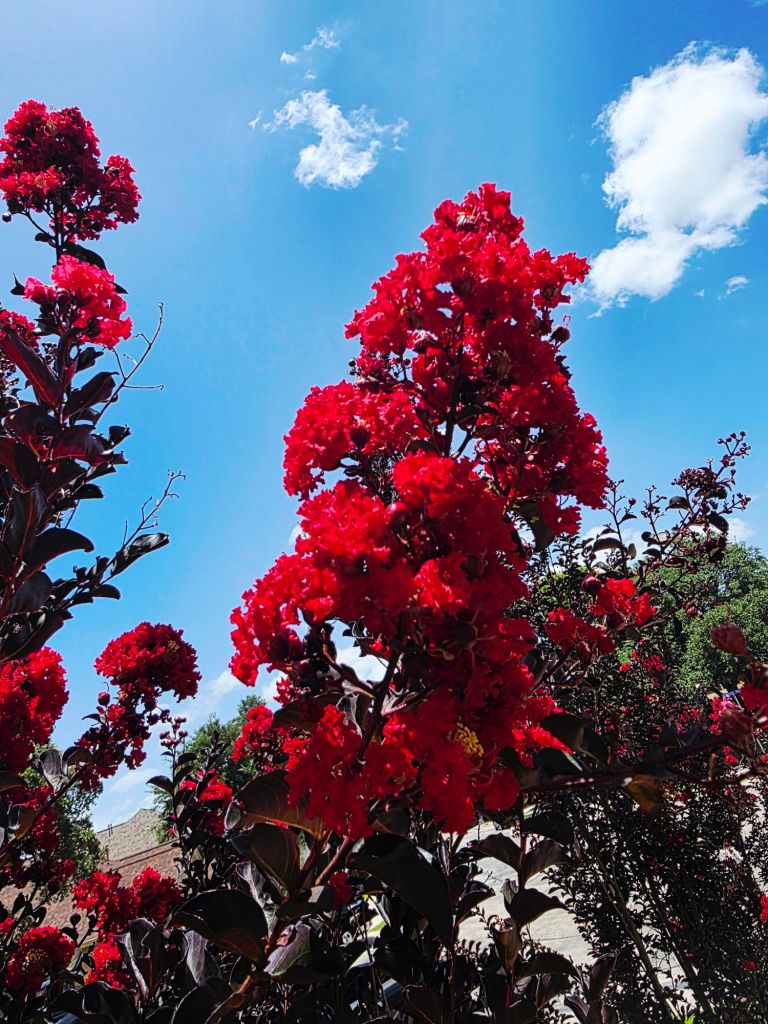
I hope you enjoyed learning how to install and care for crepe myrtles in south Texas! I’ll meet you out in the garden to admire their blooms.
Crazy Green Thumbs
Discover more from Crazy Green Thumbs
Subscribe to get the latest posts sent to your email.
 Crazy Green Thumbs
Crape myrtles have become so cliche. I am one who typically does not like them at all, mainly because of their overuse in the landscape industry. However, we grow several at work, where I like how everyone else likes them. Weirdly, my least favorite is ‘Natchez White’. I am unimpressed by its whiteness. Besides, crape myrtles excel at vivid colors, not pale white. I might not mind it so much if the white were brighter. Yet, it has the best foliar color for autumn, which I am impressed by.
Everything here is planted in native soil, which is naturally of reasonably good quality. Some areas are a bit too sandy, so I must plant species that survive in sand there. I want nothing that requires amendment. It annoys me that some want to argue that amendment is ‘necessary’. Those who do so are not as experienced with horticulture as I am.